

Why the morning ritual matters more than the morning pages
On writing as ceremony, and what gets lost when we confuse productivity with preparation.

It’s 5:47 a.m.
You’re awake before the alarm because something woke you. A line, a fragment, a sentence that almost had you. Or maybe because of a wild-ass dream you can’t make sense of (this is a regular occurrence for me). You reach for your phone in the dark and type it into the Notes app before it dissolved. You read it back twice. You don’t know if it’s good. You just know it’s true.
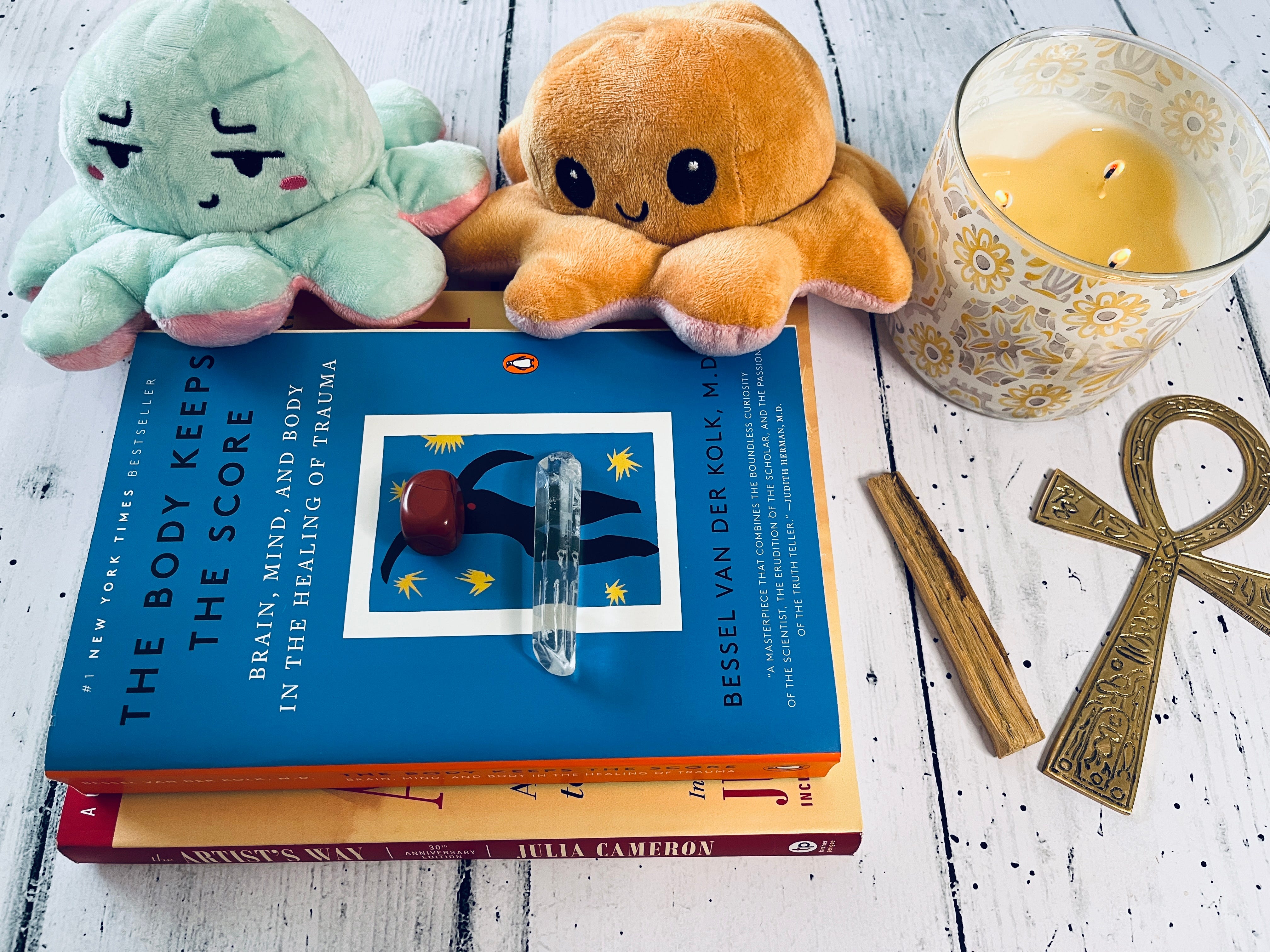
You invoke Goddess Caffeina by making coffee — or in my case, a strong British brew. On your counter: a dog-eared copy of The Body Keeps the Score, a tarot deck wrapped in a scarf your aunt gave you, a bottle of Florida Water you forgot to move. On the bookshelf behind you: your grandfather’s photograph in a frame you haven’t dusted, a white candle burned down to its last inch, a sprig of something dried that you put there in November.
You open your laptop. You have an hour before the day starts claiming you.
You open a Word document titled MANUSCRIPT_v14_FINAL_forreal.docx. You read the last paragraph you wrote eleven days ago.
Your chest tightens. You close the document. You’ve been swallowing this paragraph for two weeks.
You open a browser instead. You end up reading three Substack essays, saving a fourth and closing the tab. The desktop experience is always better than the app.
You think:
I should be writing. I can’t write like this. I just need a system. People swear by morning pages. Maybe I should try that again.
Maybe you should. Or maybe — and I want to say this carefully, cuz I know I’m about to agitate some demons — the problem was never the system.
— ✦ —
— ✦ —
What The Artist’s Way Got Right (And What It Missed Entirely)
Before I go any further, lemme say this plainly: Julia Cameron wasn’t wrong. Morning pages work. Three pages of longhand, stream-of-consciousness, written first thing, as a practice of clearing the mental clutter and creating a channel for creative work — it is sound. It has helped millions of writers. It helped some writers I know and respect.
I tried it twice. The first time I made it six weeks. The second time, three.
Discipline wasn’t the problem. Saturn is my chart ruler. I have discipline for days. And I have disciplined myself to do far harder things. I stopped because every morning I sat down to do them, I felt like I was confessing into a void. Like I was emptying myself out before I’d been filled. Like someone had handed me a broom and told me to sweep before they’d shown me what the room was supposed to look like.
The Artist’s Way is a spiritual book rooted in a specific tradition: Christian recovery. The artist as a child of God, returning to a source. The morning pages as a kind of daily confession: empty the noise, make space, let the divine in. Cameron is clear about this. The framework makes sense inside the worldview it comes from.
However, that framework wasn’t built to address:
A nervous system that has been trained — across generations, not just a lifetime — to understand that being fully heard is dangerous.
Morning pages ask you to pour yourself out onto the page. For a writer whose block is rooted in a real, embodied, ancestrally transmitted belief that their full voice is not safe in this world, pouring out before you are held doesn’t clear anything. It confirms the fear. You open up, nothing catches you, so you close back down. Tighter than before.
Cameron wrote a book for a particular wound. It’s not the same wound we carry.
The Artist’s Way didn’t dismantle the surveillance. It simply gave it a schedule.
This is not a critique of Cameron. This is a diagnosis of what happens when a Black writer who isn’t blocked by creativity but by a very rational protection mechanism, picks up a framework built for somebody else’s healing and wonders why it doesn’t work for them.
They already knew how to empty themselves out. They’d been doing it for years. In the writing workshop. In the pitch meeting. In the critique group. On the page, writing characters who are legible to the centered white reader. They didn’t need more practice clearing. They needed to learn what it felt like to be filled first.
That is a different practice entirely. That is ceremony.
— ✦ —
The Difference Between Routine and Ceremony
A routine is what you do to manage yourself.
Ceremony is what you do to remember who you are.
This isn’t a small distinction. It is, I believe, the whole thing.
When I say routine, I mean: the thing you do because it helps you function. Coffee before you open email. Walking at lunch so you don’t feel like a body that has been sitting at a desk for eight hours. Morning pages so you clear the noise before you write. These things work. They are not nothing. But they are management. You are trying to get yourself under control, or get yourself into a usable state, or clear the decks so the real thing can happen. The relationship is instrumental. You are a problem your routine is solving.
Ceremony is relational. You are in relationship with something when you do it. That something might be your ancestors. It might be your own sacred self. It might be the tradition you come from, or the lineage you are consciously choosing, or simply the understanding that the work you are about to do is not simply labor, it’s an act that has a receiver. Someone is waiting for what you will write. You are not alone at the desk.
Here is what changes when you understand your morning practice as ceremony rather than routine: you stop being the person trying to get yourself to write, and you become the person being prepared to transmit.
There is a difference in the body. You feel it as soon as you name it.
In routine, the nervous system says: let’s get this going. In ceremony, the nervous system says: I am being held. I have been held before. The holding has a lineage. I can let something move through me that is larger than the noise in my head this morning.
You cannot write freely from a body that doesn’t believe it is safe. Ceremony is how you tell your body: we are safe. We are held. The ancestors are here. You can say the true thing now.
The blank page isn’t the problem. The body sitting in front of it isn’t the problem either. The problem is that nobody taught you that before you touch the page, you get to be gathered. You get to be held by something that knows your name — your real name, not the one you use at work. And that gathering, that holding, is what ceremony does.
Morning pages skip the gathering. They go straight to the output.
For some writers, that’s fine. For the writer who has been performing their way through creative spaces for years, who code-switches even on the page, who writes and then reads their own sentences with a stranger’s eye — going straight to output means going straight to surveillance. They produce words, yes. But they’re not theirs. Not fully. The little white man is already on their shoulder by the time they reach for the pen.
Ceremony puts him in his place before they open the document. This is the whole point.
— ✦ —
What Ceremony Does to the Nervous System (This Is Not Metaphor)
Your nervous system responds to signals. It’s physiology.
Your nervous system responds to signals. It’s constantly reading your environment. Not the environment you’re consciously aware of, but the environmental data your body is taking in below the threshold of thought. Temperature. Sound. Light. The quality of your own breathing. Whether your shoulders are at your ears or resting somewhere they can breathe. Whether you are, at the cellular level, in a state of threat or a state of safety.
Creativity requires safety — not comfort. You can write in difficult conditions, but the nervous system has to believe, on some level, that the act of expression is not going to get you hurt. For writers who carry the ancestral inheritance of “speaking out loud is dangerous,” that safety doesn’t come automatically. Toni Morrison described herself as “paralyzed, unable to write” after the 2004 election. The body knew something the craft couldn’t fix. Safety has to be created. Deliberately. Repeatedly. In a way the body can recognize.
This is what ritual does. Ritual is not meaningful because of its content, though content matters. Ritual is meaningful because it is repeated. The body learns: when I do this sequence of actions, what follows is safe. What follows is spacious. What follows is held. When I light this candle and speak these words and sit in this posture, I am not alone at the desk.
The nervous system, over time, stops bracing when you sit down to write. No, the white gaze on your shoulder hasn’t disappeared. The world hasn’t gotten less hostile either. It stops because the body has learned that the ceremony contains the hostility. That inside the ceremony, something else is possible.
This is why I always light a candle before I sit down to write.
This is why I pour water and make strong black coffee for my grandmother and other deities on Saturdays.
This is why I pull a card before I begin.
These things aren’t decorative. They are the mechanism by which I tell my body: we are not performing today. We are transmitting. Those are different physiological states. One contracts. One opens.
What I’ve just named is the diagnosis. I want to go further… into the actual practice.
Because understanding what ceremony does is one thing. Knowing how to build one that belongs to you… rooted in your tradition, your lineage, what your body already knows how to recognize as safe… is something else. That requires getting into the particulars.
What does my morning look like, element by element? How does my Elemental Writing Energetics framework map onto a morning ceremony, and why does that matter for what happens on the page? And how do you build a practice that is genuinely yours — not mine, not Julia Cameron’s, not your MFA advisor’s — but a ceremony drawn from your own spiritual inheritance?
That’s what continues for Temple members below.
If you tried The Artist’s Way and couldn’t figure out why it left you cold, what continues below is the answer. The practice of building a morning that’s yours, and yours alone. Upgrade your subscription, and join other Temple members.
