


Most Black writers I talk to say they want to write their truth.
But whenever I mention shadow work, they get quiet. Or defensive. Or they change the subject entirely.
I hear the same responses:
“That’s for witches.”
“I don’t mess with tarot, that’s demonic.”
“I only read Black authors.”
“Shadow work? Why, when I’m already dealing with enough trauma?”
“Why would I dig up more pain when racism exists?”
I get it. I really do.
These aren’t rejections of shadow work. They’re protective responses to very real wounds.
But they’re also keeping you blocked.
After years of working with writers, doing my own deep excavation work for personal/spiritual reasons, and building my entire creative practice around this intersection of craft and spirituality, I’ve learned the following:
Shadow work isn’t optional for Black writers trying to tell their truth. It’s essential.
And the reasons we avoid it are the exact reasons we need it most.
What Shadow Work Is (And Why Many Are Afraid of It)
Let’s start here: shadow work is not demonic.
Point blank, period.
Shadow work is the practice of looking at what’s been hidden from your conscious awareness. The parts of yourself you learned to suppress. The truths you were taught not to speak. The wounds you were told to smile through.
Whoever said shadow work was about summoning demons is foolish and close-minded. Shadow work is about meeting the parts of yourself that were demonized.
For Black and Brown writers specifically, shadow work is about excavating what survival taught you to bury. It’s about finding your voice underneath all the code-switching, the assimilation, the “twice as good to get half as much” conditioning that said your authentic self wasn’t acceptable and/or less than.
Shadow work is how you stop writing for the white gaze and start writing from your actual truth.
But as a Black woman who is also a writer and editor, I know why this feels dangerous.
For Black folks, looking inward has been weaponized against us:
“You’re too sensitive.”
“Just think positive.”
“Work on yourself and racism won’t affect you.”
“Once you open that door, you won’t be able to close it.”
That last statement is actually very true, but not in the way people who say it mean for it to be. The rest of it is bullshit, and not what I’m talking about.
Liberation-focused shadow work acknowledges this truth: some of what you buried isn’t YOUR shadow — it’s survival adaptation.
Some of what got called “shadow” — your rage, your grief, your full authentic expression — is actually your real self that oppression tried to kill.
Shadow work helps you separate:
What’s mine to heal
What was done to me
What I learned to protect myself
And for writers, shadow work answers the questions nobody else will:
Why do you freeze when you sit down to write?
Why does your body tense up when you open that document?
Why do you start projects with passion then abandon them when it gets hard or right before they’re done?
Why does every piece of feedback feel like an attack?
Why can’t you find your voice no matter how many craft books you read?
Your resistance isn’t laziness. Your writer’s block isn’t a discipline problem.
It’s information your body is trying to give you. And shadow work helps you see it and listen.
The “I Only Read Black Authors” Stance
Okay so… I’m about to say something that might piss some of you off.
The “I only read Black authors” mindset keeps you blocked.
I understand the impulse. I really do.
After centuries of white authors being centered, white stories being called “universal,” white perspectives being treated as the main perspective — wanting to exclusively consume Black creativity makes sense.
However, I’ve learned that limiting yourself to only Black authors means missing out on crucial knowledge that could transform your work and overall creative life.
Examples:
Bessel van der Kolk’s The Body Keeps the Score is — in my honest opinion — required reading on trauma and the body. It’s essential for understanding why your nervous system shuts down when you try to write. Especially for those writing memoir and it’s very vulnerable and tender.
Deb Dana’s work on polyvagal theory explains the science behind why your body goes into fight, flight or freeze mode when you sit down to create.
Peter Levine’s somatic practices help you regulate your nervous system BEFORE you write — which is the difference between pushing through resistance and actually having energy for your work.
None of these authors are Black. But the knowledge they’ve shared is essential.
Make no mistake, we also need Resmaa Menakem’s work on racialized trauma. We need Joy DeGruy’s words on Post Traumatic Slave Syndrome. We need Black authors writing from and for our experience.
It’s not either/or. It’s both/and.
The closed mindset — “I won’t learn from anyone white” — is scarcity thinking dressed up as political consciousness.
White people understand this. At my big age (I’ll be 43 in a few days), I have never heard a white person say “I won’t learn from anyone Black.” That’s because they study us and our work. We need to learn to do the same.
Knowledge is knowledge. Medicine is medicine.
Eat the meat, spit out the bones.
We take what serves and leave the rest.
So… what actually serves liberation? Reading broadly. Learning from everyone. Filtering what you’re learning through your own discernment. Building your practice and knowledge bank from multiple sources of wisdom — including your own intuition and ancestral knowing.
Our ancestors didn’t survive by limiting their knowledge sources. They used what they had, took what worked and adapted it to serve them.
We can do the same.
The Specific Blocks Black Writers Carry
These are the patterns that show up again and again when I work with Black and Brown writers. The blocks that no amount of “just write more” advice will fix.
Block #1: Inherited Silence
Your ancestors couldn’t always speak their truth.
There was a time when literacy was illegal. Being too articulate meant danger. Visibility got people killed.
They swallowed their stories to keep you (and themselves) alive.
That ancestral trauma was passed down to you. And your body remembers.
So when you sit down to write, you’re not just dealing with YOUR fear of visibility, YOUR fear of being judged, YOUR imposter syndrome.
You’re dealing with generations of “don’t tell, don’t speak, stay quiet to stay safe.”
Your resistance is ancestral wisdom trying to protect you.
The problem is: you’re not living in your great-great-grandmother’s reality. But your nervous system doesn’t understand that.
Shadow work helps you witness that inherited silence with compassion, then gently show your body: we’re safe enough to speak now.
Block #2: The White Gaze Wound
You’ve been taught:
Your voice isn’t “professional enough”
Your stories are “too niche”
Your perspective needs to be understood by everyone aka white readers
Your authentic expression is “too much”
You code-switch on the page without even noticing anymore.
You explain cultural references Black readers already know.
You soften your rage so you’re not “the angry Black writer.”
You perform respectability in your characters, your language, your themes.
You’re not writing. You’re performing.
And you’re exhausted. We all are.
Shadow work excavates WHO you’re performing for and WHO you truly are underneath all that conditioning.
It helps you answer: What would I write if I stopped caring about whether white readers would understand?
Block #3: Productivity Culture Trauma
The advice is always the same:
“Write every day.”
“Set a word count goal.”
“Discipline over inspiration.”
“Just sit in the chair and write.”
And when that doesn’t work for you — when you can’t maintain that pace, when your body resists, when life happens (because life be life’ing) — you’re told you’re not disciplined enough. Not committed enough. Not a “real” writer.
That’s straight-up gaslighting.
Those systems weren’t designed for people navigating:
Racialized trauma in their bodies
Code-switching exhaustion from existing in white spaces
Economic precarity requiring multiple jobs
Nervous systems in survival mode from historical and ongoing danger
Family obligations that white individualism doesn’t account for
You can’t “productivity hack” your way through systemic oppression. Don’t let these so-called “gurus” lie to you.
Shadow work helps you build a practice for YOUR actual life — honoring your body’s rhythms, your nervous system’s needs and your real circumstances.
Block #4: The “Strong Black Woman/Man” Insult
You’ve been told:
Your pain doesn’t matter in certain circumstances
Your exhaustion is weakness
Your need for rest is laziness
You should be able to handle everything AND crank out a novel every six months
That’s a lie designed to work you to death.
Shadow work names that conditioning as a wound, not a truth.
It gives you permission to be human — to need rest, to feel pain, to require support, to have limits.
And being human is what makes powerful writing possible.
You can’t write truth while exhausted from being superwoman/man.
Shadow Work Is Spiritual Practice
Shadow work isn’t therapy. Though therapy helps too.
Shadow work is about relationship:
With your ancestors
With your body’s wisdom
With the parts of yourself you buried
With your creative spirit
With your higher self
It’s ritual work that may include:
Lighting candles before writing to create sacred space.
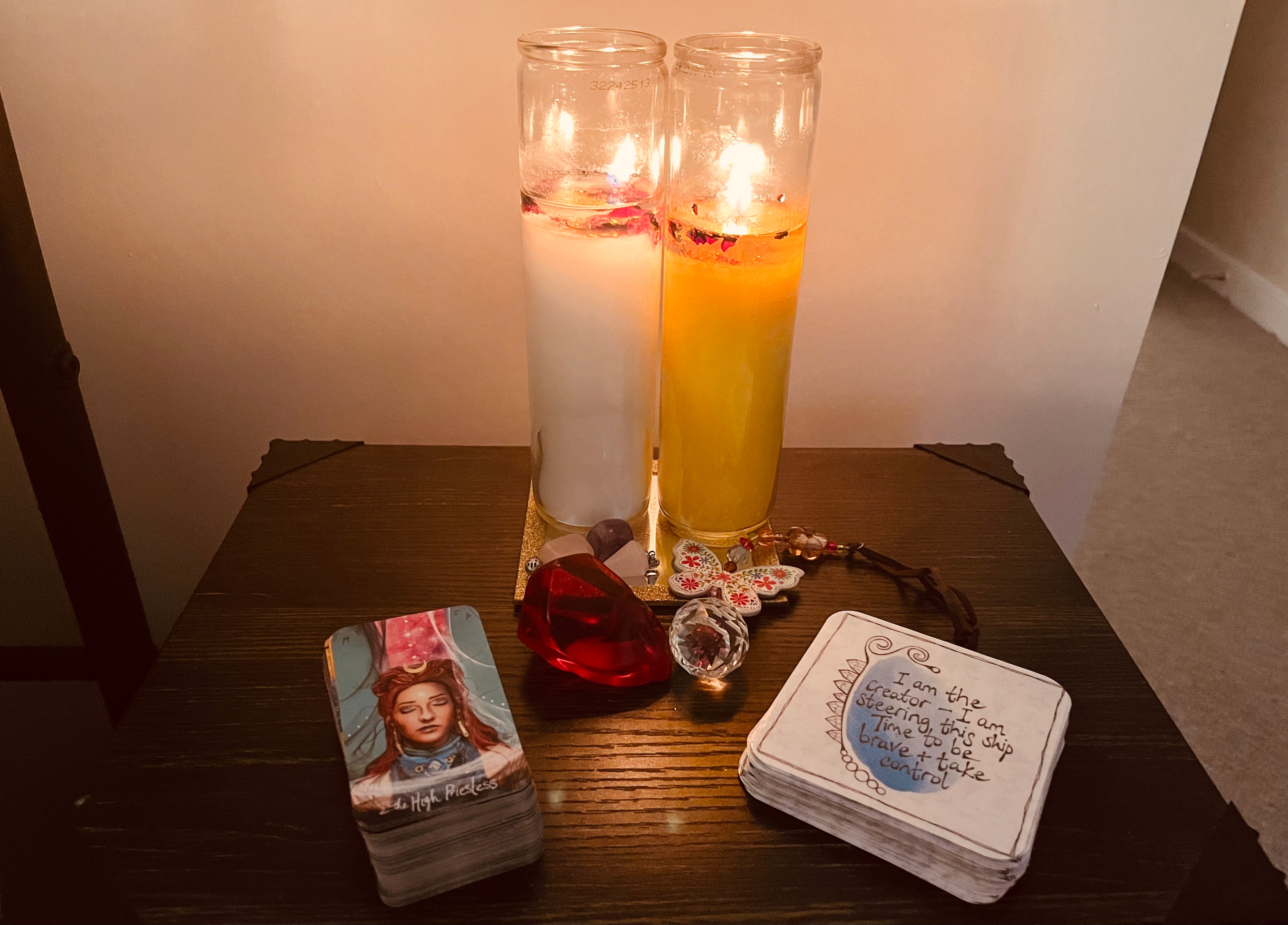
Pulling tarot or oracle cards to bypass overthinking and access intuition.
Ancestral connection practices that ground you in lineage.
Somatic practices that help your body feel safe enough to create.
It’s reclaiming what was stolen:
Our ancestors used divination. They practiced rituals. They trusted their intuition. They worked with the elements, with their ancestors, with the unseen and the Divine.
White Christianity called those practices evil to disconnect us from our power. This is still true today. We are seeing this in real time.
Shadow work is returning to our inheritance - the spiritual practices that sustained our people for millennia.
The truth they don’t want you to know: When you do shadow work, you’re not just healing yourself. You’re breaking patterns for everyone who comes after you.
Your liberation creates space for younger writers to be free too.
This is collective work, not just personal healing.
What Happens When You Shy Away From Shadow Work
You continue to stay blocked. Simple as that.
You experience writer’s block that no amount of “discipline” will fix.
Constantly self-sabotaging right before success.
Starting and abandoning projects repeatedly.
Imposter syndrome that you can’t understand.
You keep performing:
Writing for white approval instead of your truth.
Code-switching until you forget your real voice.
Explaining what doesn’t need explanation.
Making yourself smaller so others are comfortable.
You burn out:
Forcing yourself into productivity systems that don’t work for you.
Grinding until exhaustion.
Wondering why you dread writing when you used to love it.
And most importantly:
You don’t tell the stories that need telling.
The ones your ancestors couldn’t tell.
The ones that break the silence.
The ones that free your people.
The ones that are YOUR medicine to give.
The Both/And Truth
It often frustrates me how people are unable to accept that two things can be true at the same time.
You can honor your ancestors AND learn from teachers outside your culture.
You can center Black readers AND recognize that valuable knowledge exists everywhere.
You can be politically conscious AND avoid scarcity mindset around learning.
You can do shadow work AND maintain your cultural groundedness.
You can look at your wounds AND remember your power.
The liberation we’re after isn’t found in closed systems.
It’s found in radical openness filtered through fierce discernment.
Take what serves. Leave the rest.
But don’t limit yourself before you even look.
Write From the Wound: A 7-Day Shadow Work Journey
My ancestors passed their stories to me, in my bones, in my nervous system, in the way my body tenses when I speak truth. And I know I’m not the only one carrying this.
This is what I’ve been working on, and I’m now able to share it with you. I co-created this offering with my ancestors because writing is memory and writing is somatic. You can’t separate the craft from the body that creates it.
Seven days of shadow work specifically designed for Black and Brown writers who are done performing and ready to write from their truth.
Day 1: The Wound Beneath the Block Understanding resistance as information, not laziness or a lack of discipline
Day 2: The Inherited Stories Connecting with the ancestral silence you carry and why you’re the one being called to break it
Day 3: The White Gaze Wound Naming how white publishing taught you to perform, and choosing to write for your community first
Day 4: The Nervous System Truth Learning why your body says “danger” when you try to write, and how to create safety
Day 5: The Identity Excavation Discovering who you are as a writer when you’re not performing for anyone
Day 6: The Liberation Practice Building a sustainable daily practice that honors your actual life, not productivity culture’s bullshit
Day 7: Integration & The Path Forward How to keep doing this work after the seven days end
This offering is:
Self-paced (go at the pace your nervous system can handle)
Practical (prompts, practices, rituals you can use immediately)
Grounded in both writing craft AND spirituality
Designed specifically for Black and Brown writers
Anti-capitalist in approach (rest is built in, not something you earn)
This offering isn’t:
Therapy (though it’s therapeutic)
A quick fix (real transformation takes time)
About toxic positivity (we’re naming what’s real)
For everyone (only for people ready to look)
Investment: $47 | Click here to learn more
Will You Join Me?
If you’re tired of being blocked.
If you’re done performing for approval.
If you’re ready to write from your actual truth instead of who you think you should be.
If you want to stop grinding yourself down and build a practice that honors your humanity.
If you’re ready to tell the stories your ancestors couldn’t tell.
This is for you.
Your stories need you free, not bound by anyone’s limitations, including your own protective ones.
Write From the Wound is a self-paced 7-day course. I’m Lakeisha, High Priestess of The Story Temple. I help Black and Brown writers heal what’s blocking them, master their craft and navigate white publishing without silencing their voices.
I agree here! It’s imperative. My hope is that more Black people in general become more comfortable with our indigenous practices. So many people would benefit from shadow work, somatic therapy, etc.
I was especially moved by the section about folks ONLY reading black authors. When we limit or intake we limit our reach.