


March is Women’s History Month. And every year, without fail, the tributes come — the lists of women to celebrate, the retrospectives, the institutional posts about breaking barriers and trailblazing legacies. Some of it is true and some of it is theater, and Black women have always known the difference. Because Women’s History Month was not built with us at the center. The feminism that carved out this month spent decades telling us to wait, to be patient, to fight one battle at a time… which always seemed to mean the battle that mattered to white women.
We have been included in this month the same way we have been included in just about all institutions: partially, belatedly and on terms we did not set. So when March arrives and the tributes begin, Black women writers are somewhere in the acknowledgment — but rarely at the origin.
Rarely treated as the question the whole month should be asking and pondering on. This essay begins with the work of a client of mine — a Black woman writer who reminded me what it looks like to refuse every condition this month was built on… and to write free anyway.
Back in January, I read a manuscript that really left an impression on me.
It was a high stakes murder mystery — set at an HBCU, steeped in Black Greek life and full of the kind of cultural specificity that doesn’t happen by accident. The kind that only comes when a writer trusts herself enough to put it there. But what touched me so deeply was the grief. One of the characters had been carrying something for twenty years. Not explaining it, not performing it for those around her, just holding it in the way that grief lives in a body. In the panic that comes without warning. In the dream that keeps returning. In the way recognition moves through muscle before it ever reaches the mind.
My client knew that grief. She had put it on the page with a precision that only comes from having carried something a long time.
And then, she kept going. Scene after scene, chapter after chapter. She didn’t flinch. Didn’t flatten out. Didn’t reach for the safe version of the story. She stayed in it all the way to the end.
I finished the manuscript assessment, wrote the editorial letter, sent it back to her and sat with something I don’t always get to feel as an editor.
A Black woman writer who didn’t leave herself out of her own work.
I want you to hold that image for a second. Because we don’t often talk about what it actually looks like when a Black woman writer stays on the page — fully, without apology, without translation.
It looks like an HBCU setting that isn’t explained for an outsider. The Black Greek life dynamics (cuz yes, there’s a difference), the sorority and fraternity history, the specific texture of that world. She trusted that it could just be there. She didn’t slow down to make sure everyone could follow. She wrote it like it was the only world the story knew, because it was.
It looks like grief that doesn’t get summarized. The character didn’t sit down and think about her trauma in organized paragraphs. Her body remembered before her mind did. That’s how it actually works. That’s also how a writer who isn’t performing safety or palatability writes it — as a lived thing happening in real time on the page as opposed to a mere concept.
It looks like relationships that don’t resolve cleanly. The women who failed their sorority sister twenty years ago showed up at the end. They weren’t redeemed or forgiven on a schedule. In fact, they weren’t redeemed or forgiven at all. They were just present. Everything was still complicated. They were still accountable. That complexity stayed intact because the writer didn’t reach for the easier ending.
In my editorial letter, I wrote:
Zahra had been sitting with that grief for 20 years; now it’s their turn to sit with their part in it.
This is what writing true looks like. And I want to name it specifically because the alternative — writing quiet — is so common, so normalized, that most writers can’t feel the distance between the two anymore.
There’s a particular feeling that comes over a draft when a writer has started writing for someone who isn’t her.
The prose tightens in certain places. Dialect gets smoothed out. The sentences that should have heat come out lukewarm instead. Not careless, but managed. The interiority that was so specific in the first chapter starts to reach for something more general by chapter three. More universal, which is a word that has done tremendous damage to Black writers and deserves its own essay entirely.
The writer still shows up. The story is still there. But you can feel the place where she made herself smaller.
Most of the time, the writer doesn’t know she did it. She may have felt something while she was writing. A constriction. A sense of herself getting a little quieter than she meant to be. Maybe it happened at the first sentence — the moment before she committed to the dialect, the cadence, the cultural specificity that was so alive in her head. Maybe it happened during revision, when she read it back and heard herself sounding “too much” and didn’t have language for what too much really meant or whose voice was saying it.
But she’d been taught — by workshops, by craft books, by every writing program that talks about universal appeal without ever asking whose universality we mean — to push through that feeling. To treat it like self-doubt. Like weakness. Like the enemy of a finished draft.
So she pushed through.
And what came out the other side was a draft that was technically and grammatically sound, but spiritually smaller than the writer who made it.
That’s the performance wound doing exactly what it was designed to do. It doesn’t announce itself. It just teaches you to call constriction discipline, and then it waits.
Zora Neale Hurston knew this feeling.
She also refused it.
Their Eyes Were Watching God was written in seven weeks in 1936, in a Haiti boarding house, and it is one of the most fully inhabited novels in literature despite the poor reception it initially received. Zora didn’t translate Black Southern vernacular for a white readership. She didn’t make her characters’ interiority more palatable or their speech more legible to people outside the culture. She wrote Black people’s interior lives the way Black people live them during that time — with specificity, with humor, with spiritual complexity, with the full register of a language that doesn’t need to apologize for itself.
The literary establishment of her time called it folklore. Called it dialect fiction. And questioned whether it was serious literature. Richard Wright, another Black writer, said it had no theme, no message, no protest.
She was reviewed dismissively, underpaid and largely forgotten by the literary mainstream while she was still alive. She died in 1960, in poverty, in a welfare home in Florida. Her grave went unmarked for over a decade. Alice Walker found it in 1973 and put a headstone there herself.
Think about what it took to maintain that level of refusal across an entire writing career while watching what it cost her. Zora knew the performance that was being asked of her. She had been educated, decorated and celebrated in certain rooms — and she still chose the fullness of the work over the safety of palatability.
I want you to sit with that timeline. The decades between Zora’s refusal and the manuscript I read back in January. Decades of Black women writers navigating the same wound, the same standardized reader, the same institutional pressure to manage their voice for rooms that were never built for them.
The performance wound is not a personal failing. It is a survival strategy with a very long institutional memory behind it.
Here is what I want you to understand about the wound.
It doesn’t require you to be a bad writer. It doesn’t require someone who doesn’t love her culture or her language or her people. It doesn’t even require a conscious choice.
All writers want their work to be read. That’s not a compromise. That’s not being a sellout. That’s the whole point of making something — you want it to meet somebody. But somewhere in the machinery of traditional writing education, wanting to be read got collapsed into writing for the people who decide what gets read. And for Black women writers, that has almost always meant writing for a readership that was never us, inside institutions that were never built for us, toward a standard of universality that was never universal.
The writer whose manuscript I read and assessed didn’t fall into that collapse. She wrote true — all the way through, all the way to the end — and it made everything land harder. The grief hit because she didn’t soften it. The relationships had complexity because she didn’t resolve them cleanly. The setting had specificity because she trusted it enough to leave it specific.
What does that feel like from the inside? I think it feels like staying in the room when everything in your training is telling you to step back. Like committing to the sentence you first heard in your head instead of the safer version that followed. Like trusting that the reader who needs your work will find it — and writing for them, not for the white reader publishing taught you to keep in mind.
My client wrote for the story. Not for the white reader we as Black writers are trained to center. And that is an act of resistance that most writing workshops will never name as such — but it is. Every time a Black woman writer chooses her own language over the managed version, stays in the body of a character instead of summarizing the feeling, leaves the cultural specificity intact instead of translating it — she is doing something Zora did all throughout her writing career that still hasn’t become unremarkable.
It should be unremarkable by now.
It isn’t.
So I’ll ask you directly: when you sit down to write, who are you writing for?
Not who you say you’re writing for. Who you’re actually writing for when you smooth that sentence out. When you take the dialect back out. When you read the paragraph back and decide it’s too much — too specific, too loud, too Black, too you.
Who told you that was too much?
And are you still letting them sit in the room while you write?
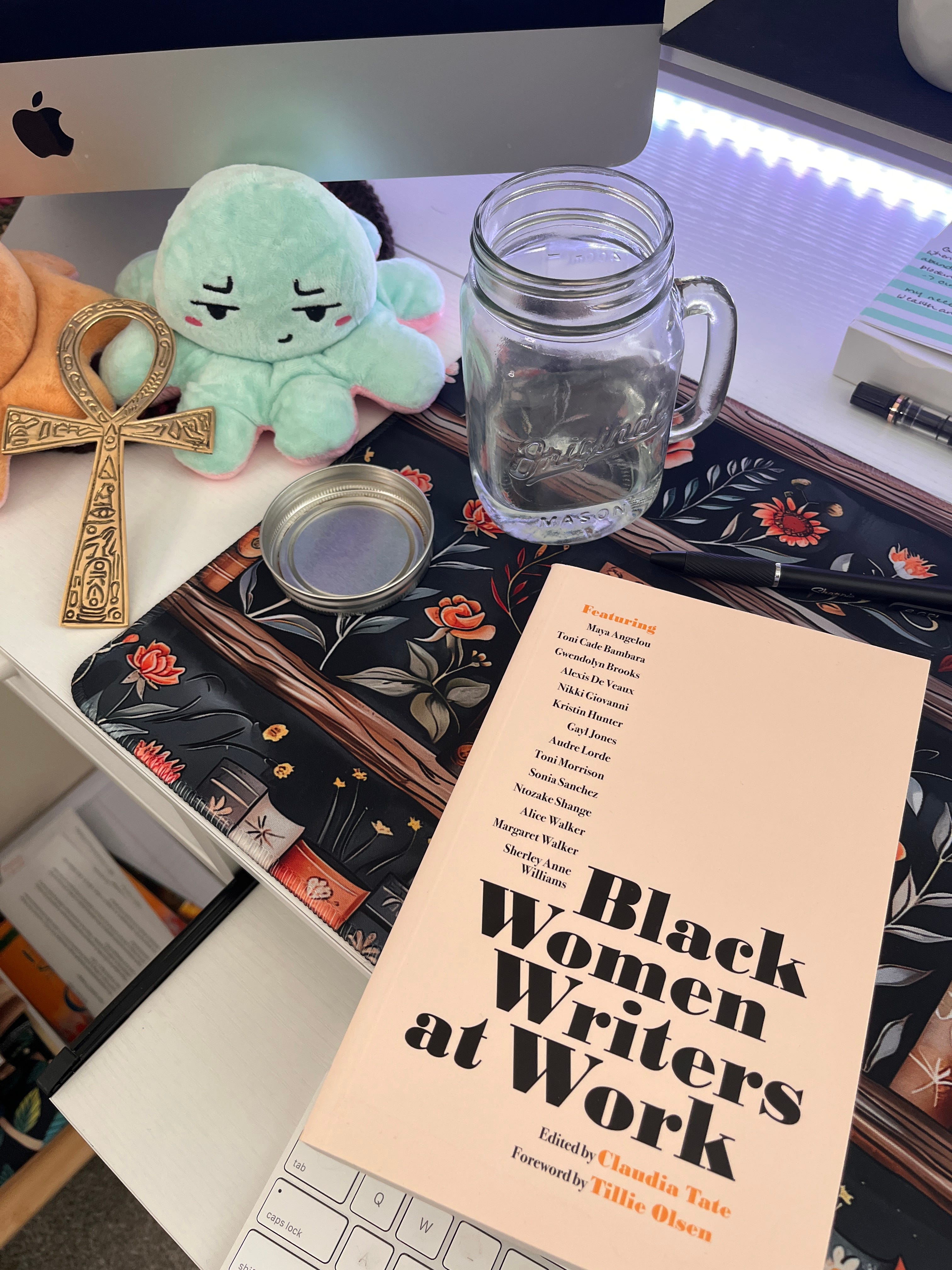
If the performance wound is what’s been running your first drafts, this is where you begin.
Write From the Wound is seven days of going underneath what’s been making you write small, so you can find out what you actually sound like on the page.
Write From the Wound → $47. Seven days. Your voice was never the problem.
with love from the waters,
High Priestess Lakeisha
This is so spot on! I’ve noticed that even in my personal writing, I’m filtering. I never noticed it. Thought I was just being polite. Or palatable (you know in case somebody picks it up to read one day). And on a deeper level, it’s hard to stay with the realness when you’ve lived your life shrinking!
I know this is going to be a very conscious repatterning. It’ll take dealing with those shadows so they don’t run the show or the page in this case.
Lakeisha, this is a powerful and generous essay. Thank you for sharing it.
As a white woman who has spent fourteen years editing books and stories by Black women, I’ve been deeply moved by the honesty, courage, and brilliance that comes through in their work. I would never claim to fully understand the generational trauma Black women carry, but I’ve learned so much simply by listening—on the page and in conversation.
One thing I’ve noticed over the years is how often Black women are encouraged, implicitly or explicitly, to soften their voices or write quietly. Supporting writers as they step into the fullness of their truth has been one of the greatest privileges of my career. Their trust has shaped me in ways I’m profoundly grateful for.
Working so closely with Black women has also made me more aware of the privileges I hold and the responsibility that comes with them. My life has had its own challenges, but those experiences are not the same—and I’m mindful of that. What I carry forward is a deeper commitment to listening, honouring, and amplifying the voices of the women who have taught me so much.
Your essay is a powerful reminder of why those voices matter—and why they deserve to be heard boldly, unapologetically, and without restraint. Thank you again for this piece. It resonated deeply.