

What’s growing underground
A meditation on the Temple’s origin, worthiness and the faith it takes to build something you can’t see yet.

A few months after I launched my editorial business in 2020, a Black romance writer reached out to me in frustration.
She had paid $2,600 for what her editor called “comprehensive editing” on her 75k-word manuscript. Eight weeks later, she got her book back with corrected grammar and a few consistency fixes. Basic copyediting. Not the structural work she had paid for. Not the work her manuscript actually needed.
Her beta readers were still saying the same things they said before she spent the money. I got lost halfway through. The ending felt rushed. I didn’t understand why the main character made that choice.
“I don’t get it,” she told me. “The editor said they fixed everything. But agents are still saying no, it needs more work.”
The structural problems that were preventing an agent from picking it up? Still there. She’d been charged developmental editing prices for surface-level work. And she had no way of knowing the difference because nobody had ever explained it to her.
When I wrote about this in an essay1, I received comments from white editors who said it was her fault. That she should have known what kind of editing she needed before she hired anyone. That she should have done her research.
What they didn’t say — what they never say — is that white writers make the same mistake. I know this from experience because I’ve had white writers as clients too. Writers of every background overpay for the wrong edit, misread what their manuscript needs and/or put trust in the wrong person. The difference is that when it happens to a white writer, it’s an unfortunate experience. When it happens to a Black writer, it’s evidence of something they should have known.
The publishing industry operates on insider knowledge that Black writers are not systematically given access to. We are expected to navigate a system built on assumptions about what we already understand, and then blamed when we make expensive mistakes inside that system.
Something took root in me after working with her.
Not immediately. Not loudly either. I wasn’t enraged or anything like that.
It was more like a question I couldn’t stop asking: What would it look like to build something specifically for us? A container where Black and Brown writers weren’t navigating a system designed to exclude them? Where the knowledge wasn’t gatekept? Where the work could just be the work?
I didn’t have the answer back then. This was during the height of covid and the lockdown. I had lost my corporate job because of the crisis, and started my business to feed my family. The Story Temple was the furthest thing from my mind. But the question stayed. It put down roots before I had language for what it was asking.
I teach three wounds here in The Story Temple. The Silence Wound. The Worthiness Wound. The Performance Wound.
The worthiness wound is the one that’s most active for me right now.
I want to be precise about what I mean when I say that. I don’t mean I struggle to believe my work has value in the abstract. I know it does and you can’t convince me otherwise. I mean the wound shows up in my body before my mind catches up. In the moment before I send the invoice. In the hesitation before I say what I actually charge. In the part of me that has historically worked twice as hard for half the acknowledgment and called that normal.
In my writing. In my business. In my relationships. In every room where I had to decide whether I was going to take up space or make myself smaller so someone else could be comfortable.
Society does not fear Black women because we are dangerous. It fears us because we are powerful, and fear is how power gets managed when it can’t be controlled. The conditioning that tells Black women we are less than, that we have to prove our worth to be accepted, that our presence requires justification — that conditioning is not accidental. It is structural. It is intentional. It is by design.
The worthiness wound is what happens when that conditioning gets inside. When you start to believe, even partially, even in the quiet before-sleep hours, that maybe they’re right. That maybe you are too much. That maybe you should wait until you’re more ready, more qualified, more certain, more [insert whatever this is for you].
This is why shadow work is important. I know my worth is priceless. I know it in a way now that I didn’t know it when I started this business. But healing is not a destination you arrive at and stay. New things come up. Old patterns surface in new situations. You heal, then life gives you something that tests whether you truly healed it or just learned to talk about it differently.
Here is what I have learned: you can build something real while still healing the wound it grew out of.
You do not have to be fully healed to begin. You do not have to have resolved every question about your own worth before you create a container that is about worth. Sometimes the building — the creating — is part of the healing. Sometimes Spirit gives you the assignment before you feel ready, because the readiness comes from doing the thing, not from waiting until you feel like you deserve to or are qualified enough now.
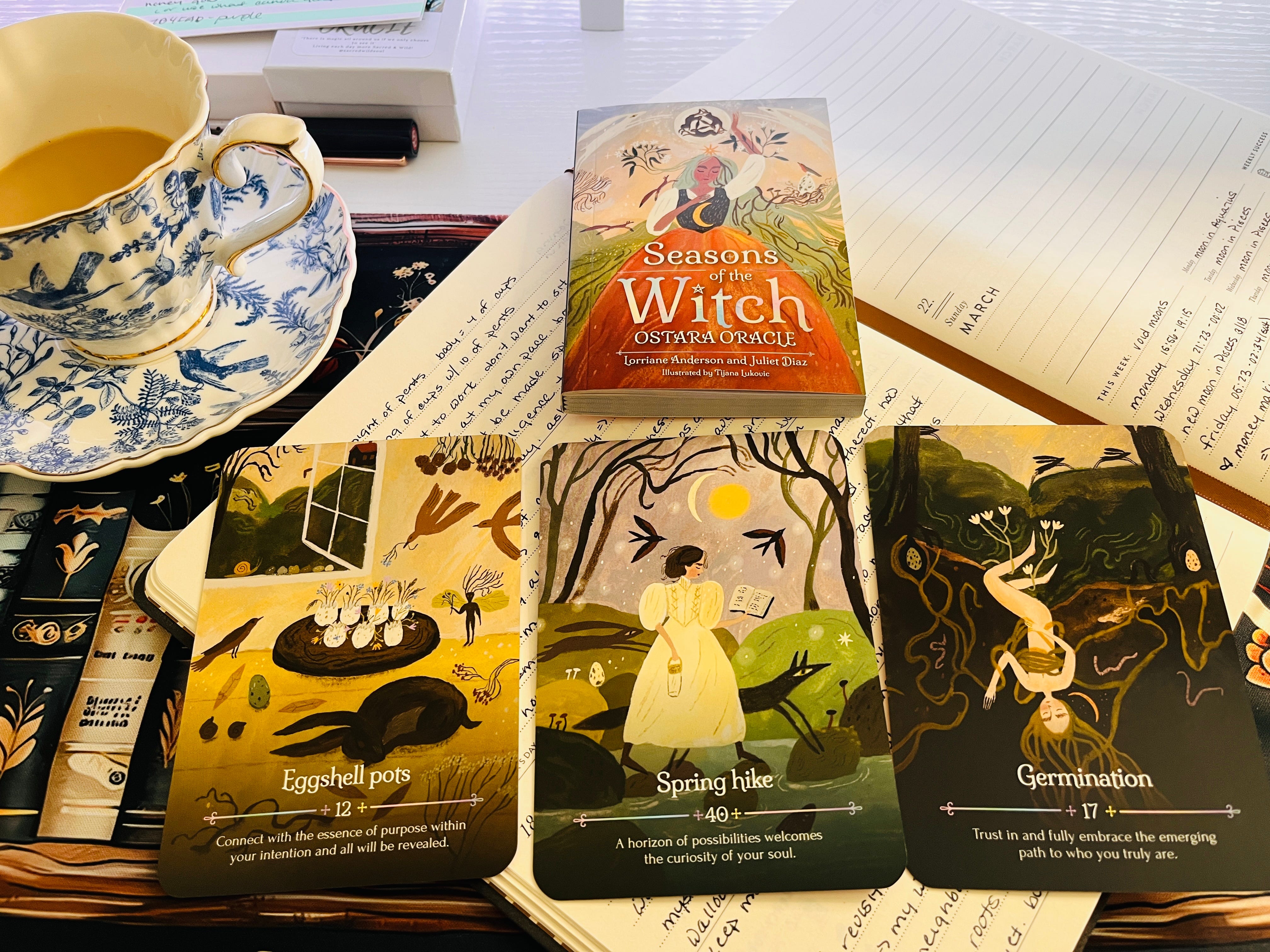
I pulled cards this morning. Mind. Body. Spirit.
Eggshell pots. Spring hike. Germination.
The Germination card says: Trust in and fully embrace the emerging path to who you truly are.
This week, an essay I wrote got one like. And that one like was me cuz I always like my own stuff. A restack of a single sentence from someone else’s article got about fifty likes and is still making the rounds. The notes I’ve been writing carefully, with intention… some of them are going out into what feels like silence.
And then someone replied to an email I sent yesterday:
It costs a lot. And I wonder what would happen if we just let all of US out onto the page. What else would shift around us?
It helped remind me what germination really is.
It’s not the moment the plant breaks through the soil. That’s visible growth. That’s what everyone celebrates and screenshots and calls progress.
Germination is what happens before that. Underground. In the dark. When the seed is doing everything it needs to do to become something, and there is no visible evidence that any of it is working.
The roots are growing. You just can’t see them yet.
I think about my client who paid $2,600 for the wrong edit. I think about what it took for her to reach out to a stranger, to explain what happened, to trust that someone in this industry might be different. That wasn’t her being naive. That was a root. She was still reaching toward something even after being burned.
I think about every moment the worthiness wound told me to stop. To wait. To be more ready. To prove something first. And how I kept going anyway because Spirit kept giving me the assignment and I kept saying yes even when I wasn’t sure. Even though I knew I hadn’t healed the wound.
Some will say this is confidence. I call it faith. And those are two different things.
Confidence says: I know this will work.
Faith says: I don’t know if this will work, and I’m doing it anyway because it’s what I’m being called to do.
The Story Temple is meant to exist. As a beacon. I know that the way I know things before I can explain them. The roots are growing. Even when the numbers are quiet. Even when the algorithm is doing what it does. Even when I am writing into what feels like a void and the void doesn’t write back.
The spring equinox is tomorrow. I’m going to keep watering these roots.
with love from the waters,
High Priestess Lakeisha
Seeds are totally germinating. Everything you write pulls at something deep within me. I often have to step back and spend time with it.