

What the cards see that the edit can’t
What happens when a developmental editor stops looking at the pages and starts reading the writer — a look inside the Shadow & the Pen.

She came to the session with her manuscript open.
The way you carry something you’ve been holding for a long time. Three years of work. Three years of drafts, of revision, of knowing something was wrong and not being able to articulate it well enough to fix it. She had received editorial feedback in the past. Genuine feedback. Careful feedback. The kind that points out the structural problem in act two and the place where the main character’s interiority goes flat in the final third. She revised, yet the flatness was still there.
She said: I know what’s wrong on the page. I just can’t seem to change it.
This, or some version of it, is the sentence I’ve learned to listen for because it almost always means the problem isn’t on the page at all.
— ✦ —
There’s a distinction I’ve come to think is essential, and nobody really talks about it:
A craft problem lives in the manuscript. It can be seen, diagnosed and revised. Developmental editing and manuscript assessments are built to do this. They find the structural fracture, the pacing failure, the place where emotional logic breaks down. These are precise diagnostic tools and I believe in them completely. How could I not? I’m a developmental editor.
A voice wound lives in the writer. It shows up in the manuscript. You can see it at the sentence level, in the hedged interiority, in the flattened desire, in the scene that softens right before it gets true. But you can’t fix it from the manuscript side. You can revise the symptom, sure. But the wound stays.
Most writing programs treat every problem like a craft problem. They give you better notes, more sophisticated feedback, finer-grained tools. And if the problem is structural, that works. But if the problem is a voice wound, if what’s holding the manuscript hostage is a Silence wound or a Worthiness wound or a Performance wound sitting underneath the pages, an editorial letter isn’t gonna move it. You will revise into the same flatness every time. Why? Because you’re working on the wrong layer.
The Shadow & the Pen is a session that works on the right layer.
— ✦ —
We didn’t talk about act two of her magical realism novel.
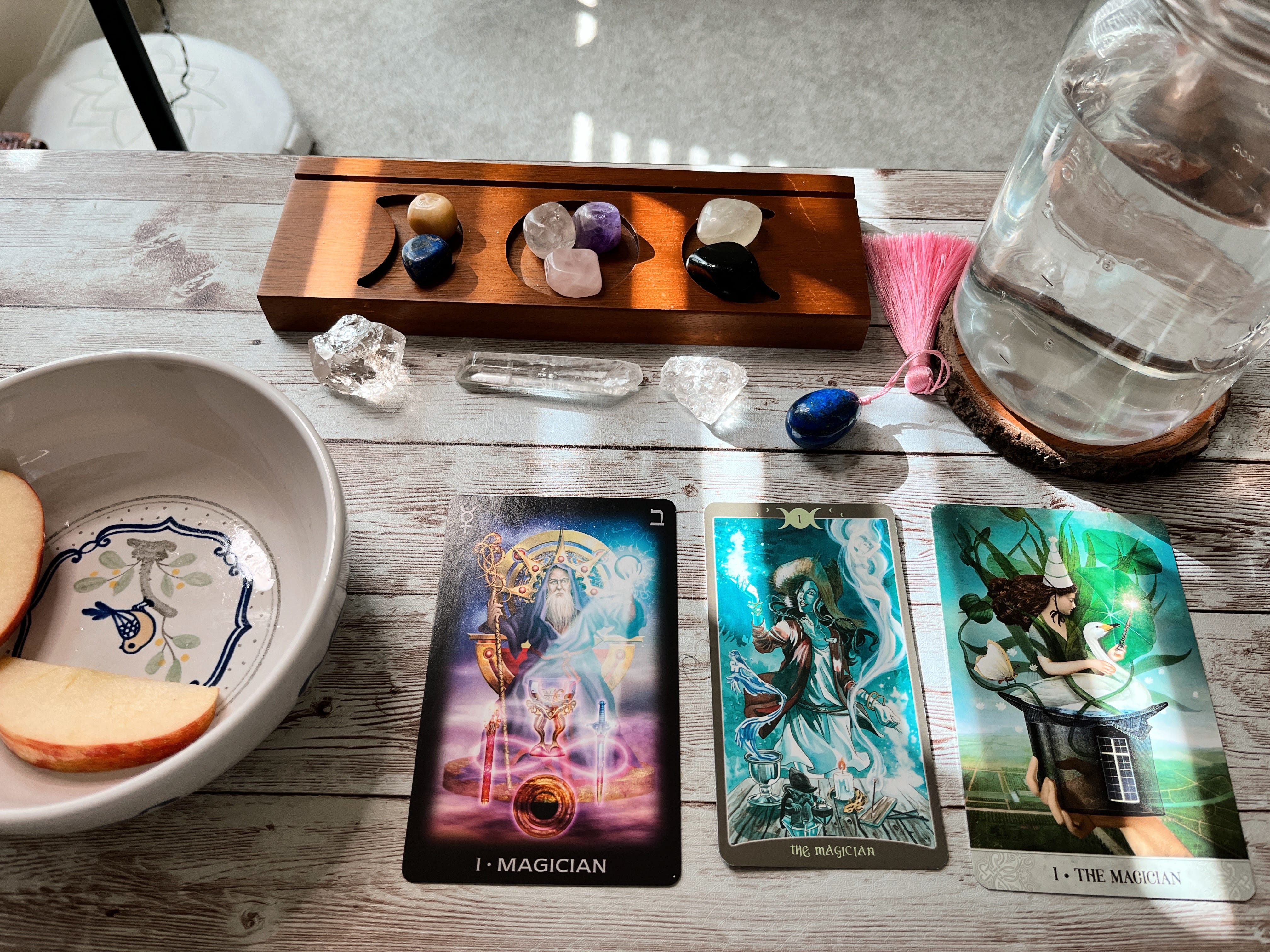
We pulled cards instead. I asked her what she was most afraid her manuscript was saying about her. Not about the main character, about her as a writer. She went quiet for a moment. Then she said something that she may have written in her journal, but hadn’t said out loud to anyone before: that she was afraid the book was too much. Too specific. Too spiritual. That no one outside of her community would understand it, and that she’d been writing with that fear for so long she’d stopped noticing it.
The card that came out was the Hermit. Meditative. Solitary. Interior. Holding the light inward, not outward.
I said: what if the book isn’t too much? What if you’ve been writing it for people who were never meant to receive it?
She started crying. Not the kind that means something broke. The kind that means something finally got named.
We didn’t return to the manuscript after that. Instead, we talked about who she was writing for, and why the imagined white reader had moved into her creative process like a tenant she’d never invited and never quite figured out how to evict. We talked about the spiritual elements she’d been softening like the rituals and the ancestral presence in the story because she was afraid of being called ’too niche,’ which is a phrase that means: too Black, too specific, too unapologetically yours.
By the end of the session she’d made one concrete decision: she was going to write the next chapter for her grandmother. Not for the market. Not for an agent. But for the woman who appears three times in the book and who she’s been keeping at arm’s length because she didn’t know if it was a good idea to put her grandmother fully on the page.
— ✦ —
Tarot is a diagnostic tool. I want to be clear about this because I know some of you came through secular literary culture and the word ‘tarot’ still activates the part of your brain that wants to qualify, to footnote, to make sure the people in the room know you’re also serious and rigorous and not just being woo.
The cards work.
Here’s the mechanism, without mysticism: a tarot card is a mirror that doesn’t lie. It surfaces what you already know but haven’t let yourself say directly. The image, the symbolism, the question it opens… these create a container for the unconscious to speak in a register that linear thinking can’t often reach. It isn’t supernatural. It’s a different kind of diagnostic. Numerology works the same way in terms of pattern recognition. The numbers in your name, your birth date, the timing of when you started this book. They act as a map. These tools aren’t looking at the pages of your manuscript. They’re looking at you.
And for a writer whose block isn’t in the craft but in the wound, that matters a great deal. Because you can’t revise your way out of a wound. But you can name it. And once it’s named, it loses the power that unnamed things have: the power to run your writing sessions from the inside without you ever seeing them clearly enough to push back.
— ✦ —
Uranus moved into Gemini for the first time since 1942. Gemini is the sign of language, of voice, of the multiplicity of what we allow ourselves to say and how we allow ourselves to say it. Uranus is disruption, sudden revelation, the dismantling of structures that have outlived their use.
I’m not going to make grand predictions. But I will say this: we are in a moment that is asking Black writers specifically — writers who have been writing under surveillance, in the censored register, for the centered white reader — what happens when the old structures stop holding? What happens when the old guard falls? What voice comes through when the architecture of approval starts to crack?
That isn’t an abstract question. Or even a hypothetical one. It’s a writing question. It’s a manuscript question. And it’s the question sitting underneath every session I hold.
— ✦ —
The Shadow & the Pen is a 90-minute session for the writer who knows something is wrong but can’t get to it from the manuscript side.
We work with your manuscript and with you. We pull cards and look at your personal numerology. We name the wound that’s been running your writing sessions. We find the layer underneath the craft problem: the voice problem, the permission problem, the white reader on your shoulder who moved in and never left.
If you’ve been revising into the same problem. If you know what’s wrong and can’t change it. If you’ve gotten good notes and the block is still there, this session is for you.
I’m a developmental editor. I know how to read and assess a manuscript. But I’ve learned that the most important reading in the session is rarely the pages.
— ✦ —
With love and fire,
High Priestess Lakeisha
𓂀✧⟡