


I got the white gaze off my shoulder, and then I couldn’t write.
For years I worked to get free of it. I named it in writing workshops. I pointed it out for my clients. I got really good at pattern recognition and catching the small betrayals. Things like words swapped out cuz they felt too much like home. Scenes being sanded down until anybody could stand in them. Then one afternoon, I sat at my desk with my shoulder finally empty, and the sentences went slack in my hands.
I wasn’t blocked. Blocked is when the words won’t come. This was something else. The words came fast and heavy, and they had nowhere to go. I was writing to no one. It took me a while to find the word for what that was, cuz I didn’t expect to need one. The word was adrift.
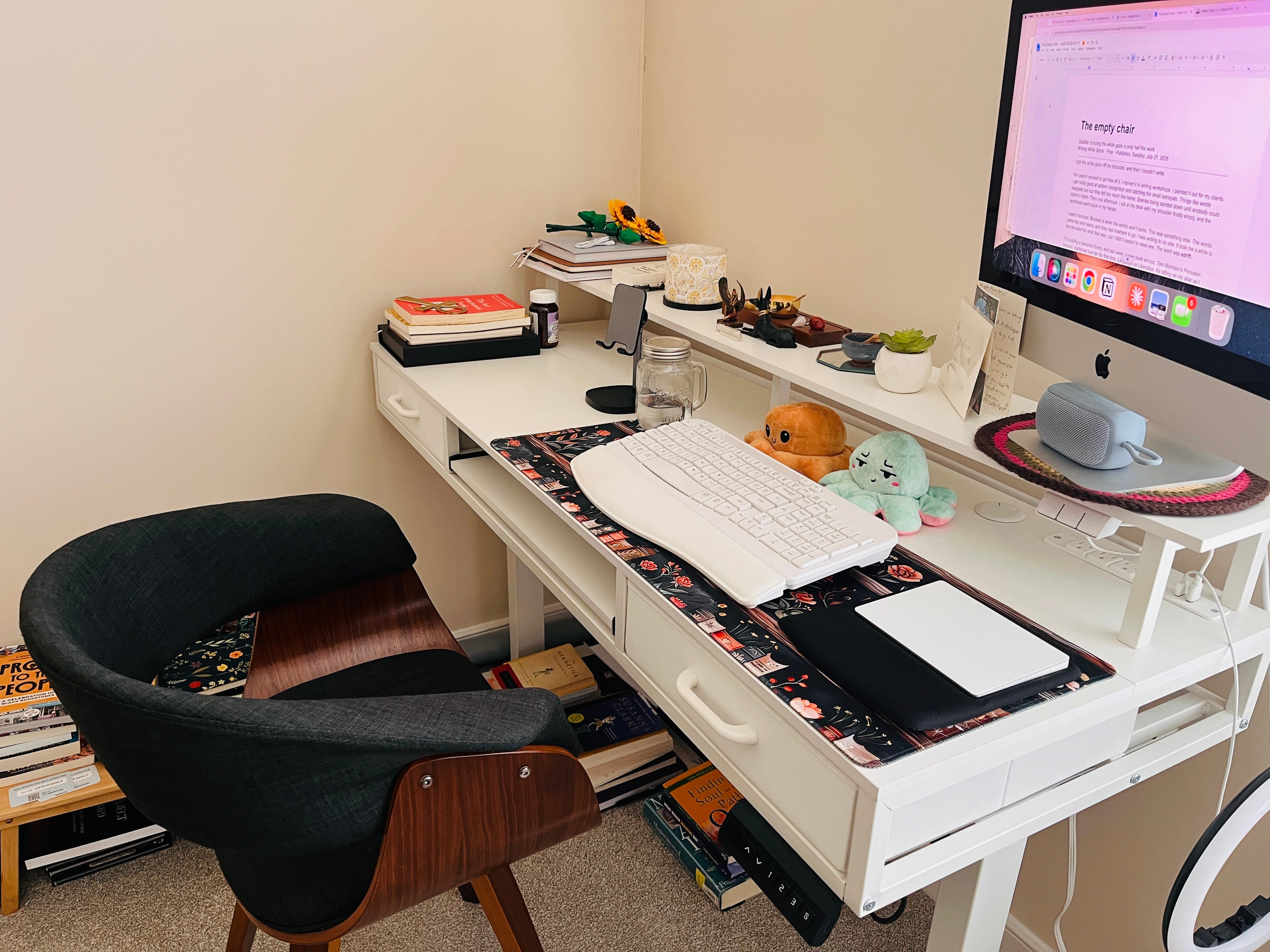
I’m building a personal library, and last week, a new book arrived. Toni Morrison’s Princeton lectures, published now for the first time, Language as Liberation. It’s sitting on my altar as I write this. Mercury retrograde is almost over, and I’m waiting for it to turn direct before I open it. I want her words to land in my spirit and not come through the fog of a backward season. She gets my full attention or she waits. That’s the least I owe a woman who spent her life refusing to write with somebody looking over her shoulder. I already know what she taught in those rooms. She said it plainly for decades before Princeton let it out of the archive.
When you finally put the white gaze down, the chair stays empty for a minute. That minute terrified me.
Morrison knocked the gaze off the shoulder. Baldwin showed what the eyes could do once it was gone.
It’s been in my bio for years. What I didn’t understand until my own sentences went slack is that those are two separate acts. Getting the gaze off you is only the first act. There’s a second act that isn’t talked about or taught. A voice has to be aimed at somebody. Free the eye from the watcher and it still has to turn and look at something.
Look at what Morrison did with hers. She turned the freed eye on the American canon and wrote down what she saw in Playing in the Dark, back in 1992. The same canon we were handed in school and told was universal. She saw what its authors spent their careers refusing to speak on. Melville, Faulkner, Hemingway, all of them writing in the shadow of a Black presence they wouldn’t look at directly. The canon we were trained to write toward wasn’t white. It was built on us. On a people its celebrated writers leaned on while its critics agreed not to see it. That’s the work of the freed eye. Getting the watcher off your back, then turning to look at the thing you were trained not to see.
Baldwin’s half is easy to miss, cuz it arrives as a letter.
The Fire Next Time opens with “Dear James,” written to his nephew, a Black boy about to turn fifteen. Baldwin never steps outside that address. He talks about the boy’s father, his grandmother, the block they came up on, and not once does he stop to explain any of them to whoever else picked up the book. He knew white readers would be reading. He wasn’t writing for them. The force of that letter comes from who’s in the chair, and it isn’t them.
That’s the freed eye at work. It turns toward its own people and tells them the truth.
When the chair goes empty, put somebody in it who belongs there.
Not the market. The market is the white gaze wearing a business suit.
A person. Alive, specific, somebody you could describe to me if I asked. Mine is a Black writer who came to me with their pages and an apology attached to them. Every time I sit down, I’m writing to them. When I can’t tell whether a sentence is doing its job, I ask whether it would be any use to them, and that question has an answer. The market never gave me one of those.
Other people belong in that chair too. The reader twenty years out, who will need you the way you needed the writers who came before you. The ancestor in your bloodline who was never allowed to write themselves down and is waiting on you to do it for them. Any of them will hold. What matters is that somebody is sitting there and you know their name.
When the right person is in the chair, the sentence structure changes.
You stop explaining what your reader already understands. A writer being watched writes, “My grandmother’s voice rose above the congregation during the call-and-response.” The same writer, answering to her own people, writes, “Grandma got louder than the whole church that Sunday.” The second one trusts that you get it. The explaining falls away because the reader doesn’t need it, and what’s left has room to breathe.
You let the reference stand. The gaze makes you write “red drink, the sugary punch we had at cookouts.” Your people just get the red drink. You don’t turn Big Mama into “my maternal or paternal grandmother.” You don’t follow a line of dialect with the same line cleaned up, like a subtitle running under the scene.
You keep the dialect whole. Watch what the gaze does to one line. Your character says, “I ain’t studyin’ you,” and the writer being watched can’t leave it there, so they add, “which was my mother’s way of saying she wouldn’t waste her worry on me.” Now the line is a specimen behind glass. The freed eye lets it stand and do its own work, cuz the reader in the chair heard it in their own kitchen from their own mama, and doesn’t need it handed back to them explained.
Every one of these is the same move. You quit writing to the middle of the room. And the specificity that had been leaking out of your pages comes back the second you stop translating.
There’s a difference between performing for a reader and being answerable to one.
Performance asks whether they’ll get it and let you in, and whether they’ll call it universal enough to count for something. Accountability asks a truer question. Did I tell them the truth, the way it should be told. What you owe the person in that chair is precision. Saying what needs to be said with nothing filed down to make the entry easier for a stranger who wasn’t the true reader anyway.
The assumption runs deep. A book by a Black writer gets picked up as an explanation. People read it like a translation submitted for review, whether or not you wrote it that way.
And it doesn’t only come from critics.
When you write to your people in the way your people think and talk, and some of the criticism comes from the same people you’re writing to. Too much dialect. Hard to follow. This won’t travel. Who’s gonna read this? Goes against religion. Said by us, about us, in critique groups and comment sections and reviews.
That’s what a gaze does after it’s been taught long enough. It stops being a person in the room and becomes the standard we hold each other to. We learned to check each other’s pages for how well they’d sit with somebody they weren’t written for.
So being answerable to your people costs something. Sometimes it means being misread by them. Write it anyway.
I should say that I was writing toward the gaze too. I came up in an industry where the rooms are white and white editors still get picked over us. So I wrote toward the people doing the picking. Went along to get along. I thought sounding like them was the cost of being taken seriously at my own profession.
When I turned and started writing to Black writers, as an editor, in public, people looked at me differently. That was uncomfortable cuz this is how I pay my bills. But like Baldwin, I’m writing anyway. And I can see the fruit of it now.
The sentences came back. They had somewhere to go. They’re who I answer to.
The chair was never supposed to stay empty. Put somebody you love in it and write to them (and for them). That’s who the page belonged to all along.
Essays like this land in your inbox every Tuesday. Free. If this one put somebody back in your chair, the next one will help you keep them there.
About the author

High Priestess Lakeisha is the founder of The Story Temple, a spiritual writing sanctuary for Black writers healing their relationship with their voice. She is a developmental editor with close to 10 years of experience across fiction and nonfiction, an initiated priestess, a certified evolutionary astrologer, and a shadow work facilitator. Her editorial roots are in fantasy and speculative fiction, the genre space where she first saw the patterns she would later have language for.
Lakeisha’s work holds craft and spirit as one practice. The Elemental Writing Energetics framework reads the manuscript. The Elemental Shadow Wounds framework reads the architect behind the words (the writer). The Story Temple exists on a single premise: writing is a spiritual practice, and a free sentence is a prayer being answered.
Morrison knocked the gaze off the shoulder. Baldwin showed what the eyes could do once it was gone.