


Welcome to Elemental Writing Practice
If you were here in 2025, you learned what the four elements are and how they show up in your writing through The Elemental Writing Mysteries (EWM 101-401). We spent four months building the theoretical foundation – understanding Air, Fire, Water and Earth as the elemental forces that make writing work.
Now it’s 2026. Theory becomes practice.
This year, we’re not learning about the elements. We’re learning to use them in your daily writing practice. Every month, I’m giving you one concrete exercise to strengthen a specific element in your current work-in-progress.
No more abstract concepts. No more “that’s interesting but what do I do with it?”
Just practical application. One practice at a time.
If you’re new here and didn’t take EWM in 2025, don’t worry. Each “starting with” post for each element will link to the foundational teaching so you can catch up. But you don’t need to read everything before starting. Jump in. Try the practices. Learn by doing.
We’re starting where all good writing starts: with Air.
Element Refresher
Air Element governs vision, premise and conceptual clarity – the deeper purpose that guides every decision in your manuscript. When Air is strong, you know what you’re writing and why it matters. When it’s weak, you’re adrift. (Need a refresher? Read the complete Air Element foundation.)
This Month’s Focus
This month we’re working with premise clarity – the ability to articulate what your work is actually about in one clear sentence.
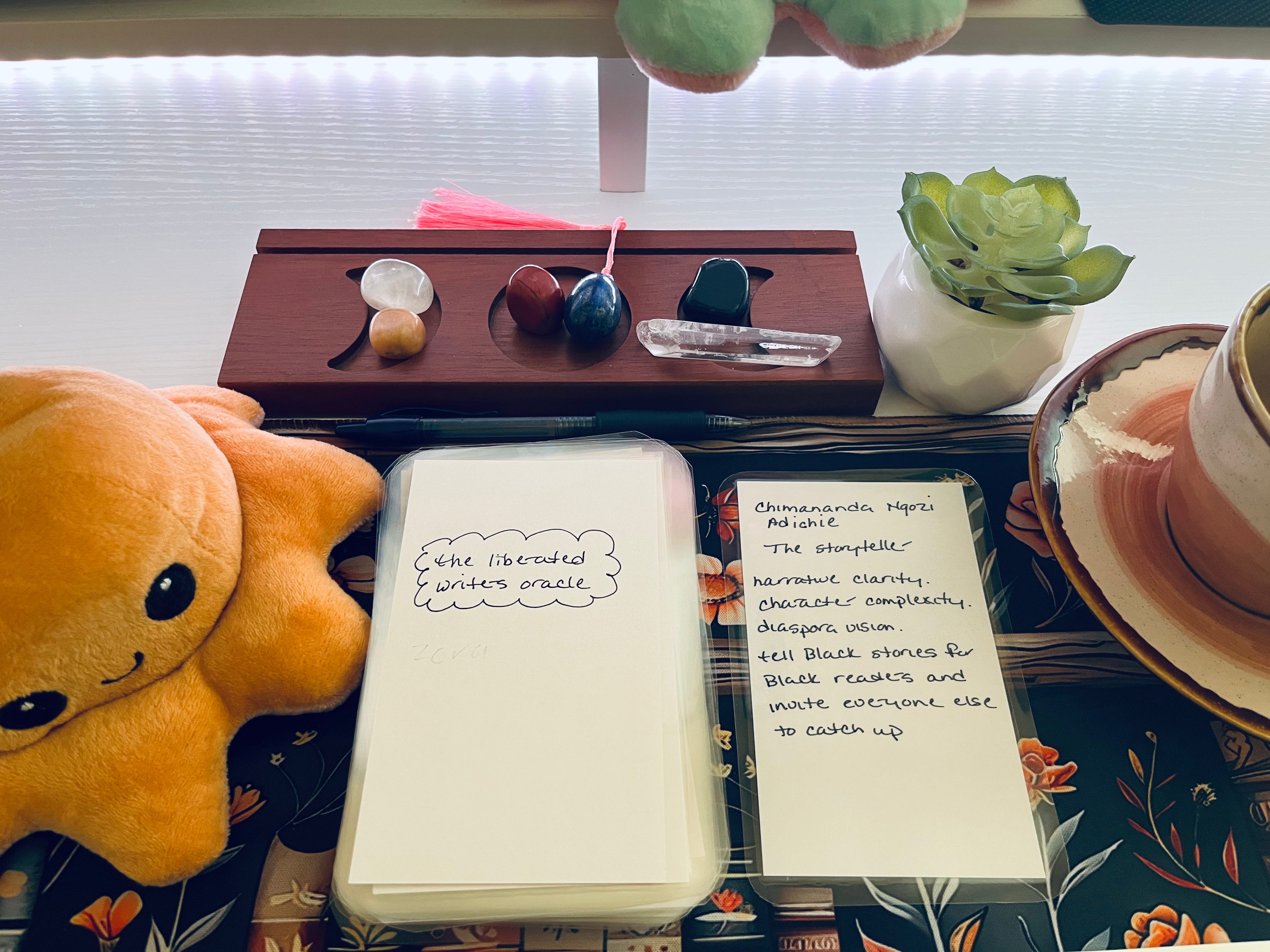
The Card Speaks
Chimamanda Ngozi Adichie - The Storyteller
Narrative clarity. Character complexity. Diaspora vision. Tell Black stories for Black readers and invite everyone else to catch up. Return to the story itself. You’re overthinking the craft and losing the tale. Trust narrative over technique.
Stop trying to fix your premise with more craft rules. Get clear on the story you’re trying to tell. Clarity comes from the story, not from technique. Chimamanda doesn’t explain Igbo words or add white characters for relatability. She trusts her vision. That’s what strong Air looks like.
The Practice
What you’re doing: The one-sentence premise test
Open a blank document or grab a sheet of paper
Set timer for 3 minutes
Complete this sentence: “This is about...”
You cannot list plot points (what happens)
You cannot list topics (what you’re discussing)
You must include what’s at stake or what’s being explored
Keep it under 25 words
Why this works: You can’t draft with clarity if you can’t name your premise. This practice forces you to articulate the real story underneath the surface content. Plot is what happens. Topics are what you discuss. Premise is why any of it matters.
What to look for:
If it came easily and feels true → Your Air is strong. Use this sentence to guide every decision going forward. Does this scene serve the premise? Keep it. Does it distract? Cut or revise.
If you struggled or wrote multiple versions → Your Air needs work before drafting more. Don’t panic. Spend this week sitting with the question. Try different versions. Pull cards for guidance. Talk it through with someone who gets your work. Post q’s in the comments for me.
If you only listed plot points or topics → You’re thinking about content, not purpose. Ask yourself: why does this plot matter? What does this topic reveal? Answer that question and try the test again.
If different versions pull in different directions → You might be trying to write multiple things at once. Pick one premise for this draft. Commit to it. The others can be different projects.
What This Looks Like
A fantasy client sent me her novel. The logline was: “A woman returns to her hometown after her father’s death.”
That’s not Air. That’s plot.
I asked her to try the one-sentence test.
First attempt: “A woman confronts her complicated feelings about her father after he dies.”
Still weak. “Complicated feelings” isn’t specific enough to guide decisions.
Second attempt: “A woman must decide whether to preserve her father’s memory or expose the truth about who he really was.”
There it is. That’s Air.
Suddenly she knew which scenes belonged – the ones revealing who the woman’s father really was, the ones showing her wrestling with the decision to protect or expose. She cut an entire subplot about the woman’s ex-boyfriend because it didn’t serve this premise. She added new material showing the father’s hidden life.
The manuscript transformed because the Air got clear.
One sentence. Three minutes. Everything changed.
Your Assignment
Before you draft anything this week, do the one-sentence test for your current project.
Write it down. Keep it visible while you work – tape it to your monitor, write it in your notebook, make it your screensaver. Use it to decide what belongs in your manuscript and what doesn’t.
Every scene, every chapter, every section should serve this premise. If it doesn’t, you know what to do.
Paid members: If you’re stuck on this practice or want help refining your premise, bring your attempts to the community thread. I’m here to help you work through it. Sometimes we need another set of eyes to see what we’re actually writing.
Start with Air. Start with clarity. Start now.
Next month: Fire Practice – The scene you’re reporting
Before You Go
If you’re working through this Air practice and noticing resistance — your body tensing up, your mind going blank, the urge to do anything except sit with the question — that’s not a craft problem.
That’s your nervous system responding to something deeper.
Write From the Wound is a 7-day shadow work journey I created to help Black and Brown writers excavate what’s really blocking them — inherited silence, white gaze wounds, nervous system survival responses that craft books don’t address.
It starts January 19. Presale is $17 through January 18 (then $27).
If you felt something reading that, join us here.
Now go do your one-sentence premise test. And report back with your findings.